
Our Senses – Year 3
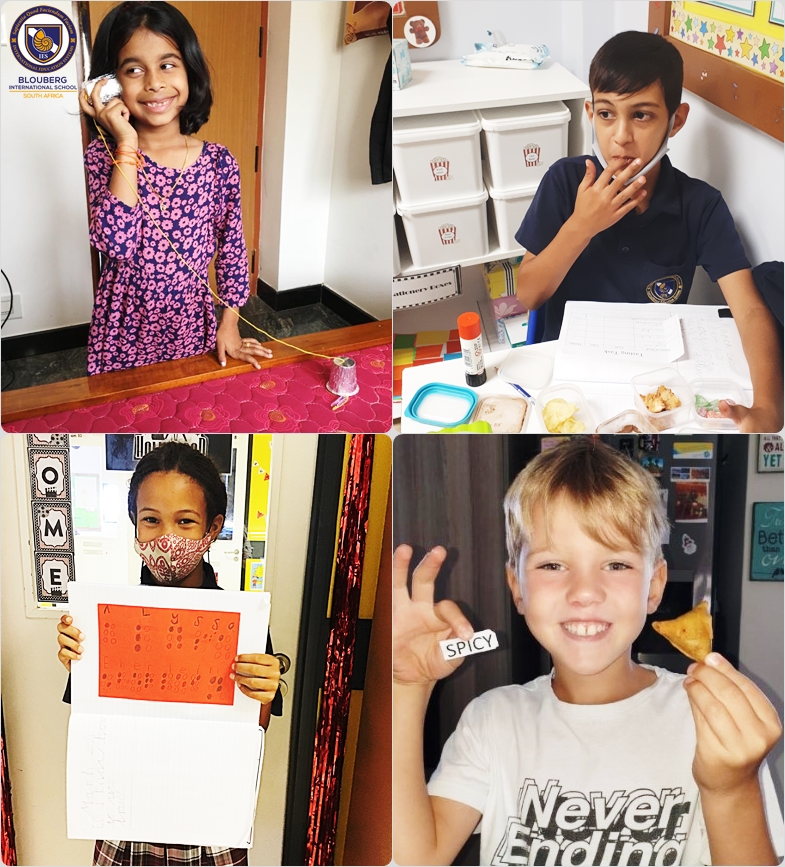
During the last few weeks of Term 1, we have been discussing and experimenting with our five senses. Although many of the students knew what their five senses are, they learnt so much more about them, using practical ways to explore them further and discover their importance.
Hearing:
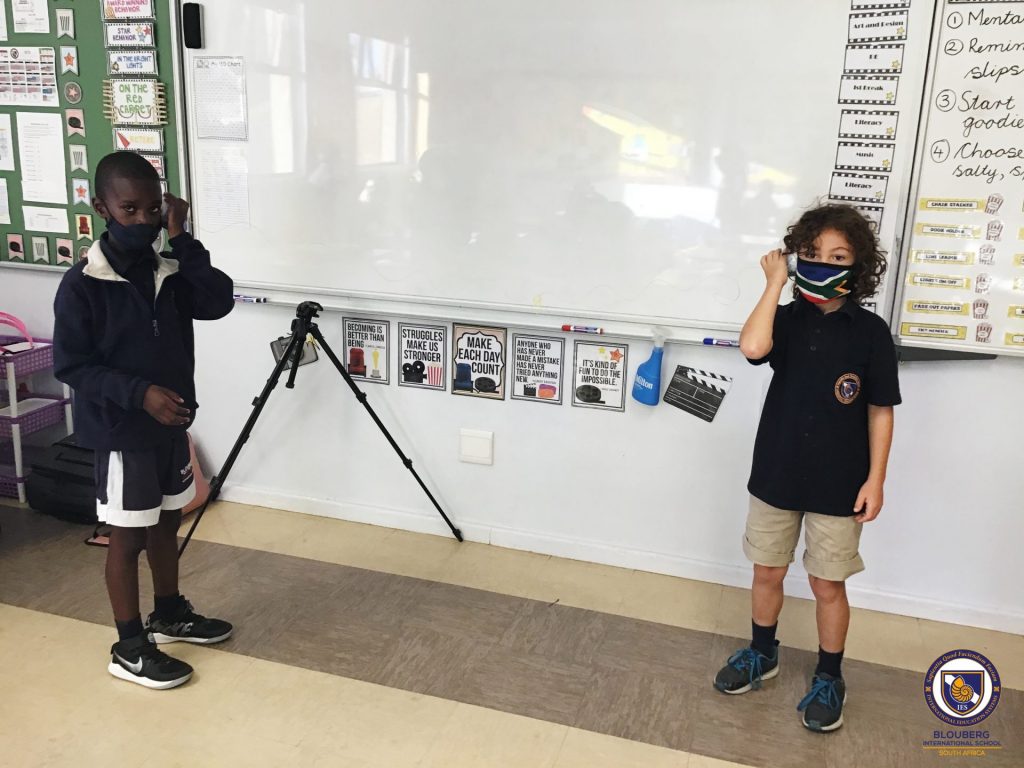
Each student made a telephone using Styrofoam cups and fishing gut. They took them outside and learnt why it works so well. This is because the gut is dense, and the sound of our voices travels down the line and into the cup on the opposite side. Thus, allowing the recipient to hear what we have to say, even from a distance.
Sight:
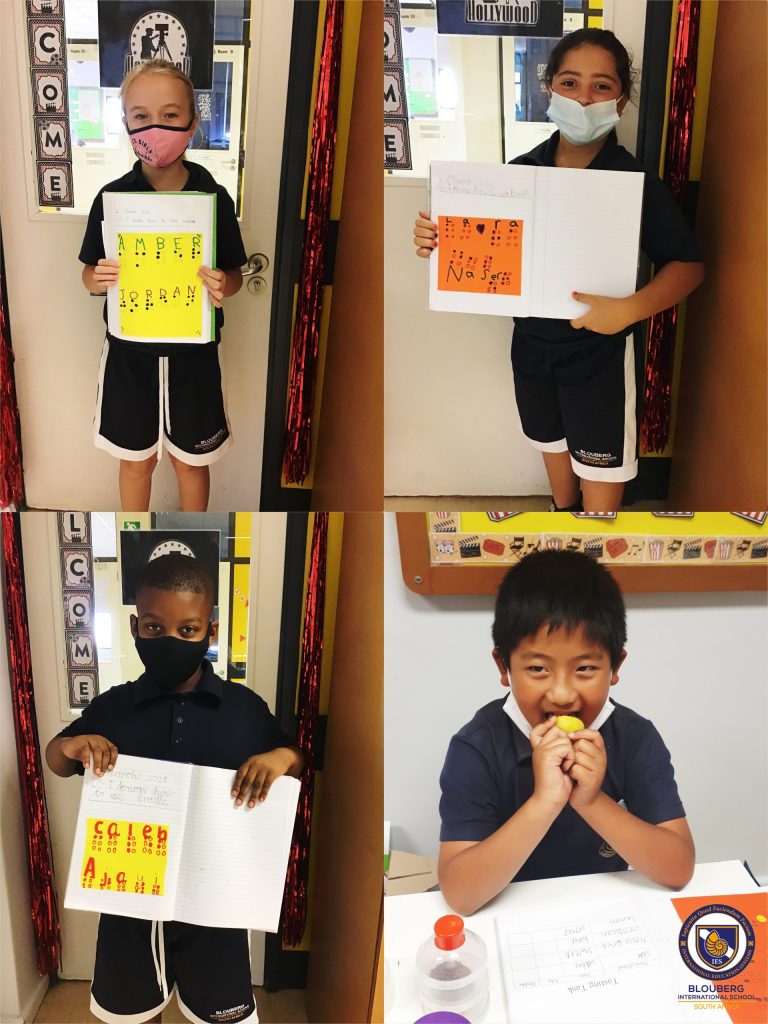
The students learnt who invented Braille and why it is so important. They saw what Braille looks like and had to use a Braille Alphabet to decipher words in a ‘Mystery Challenge’. Each student managed to write their name and surname using this amazing technique that many visually impaired people use all over the World.
Touch:
Each student was given a chance to choose an item while their eyes were closed. They had to describe it to the children in the class, and guess what they think it is without looking. It was rather interesting to see what a daunting task it can be to describe something using words, without seeing the actual item.
Taste and smell:
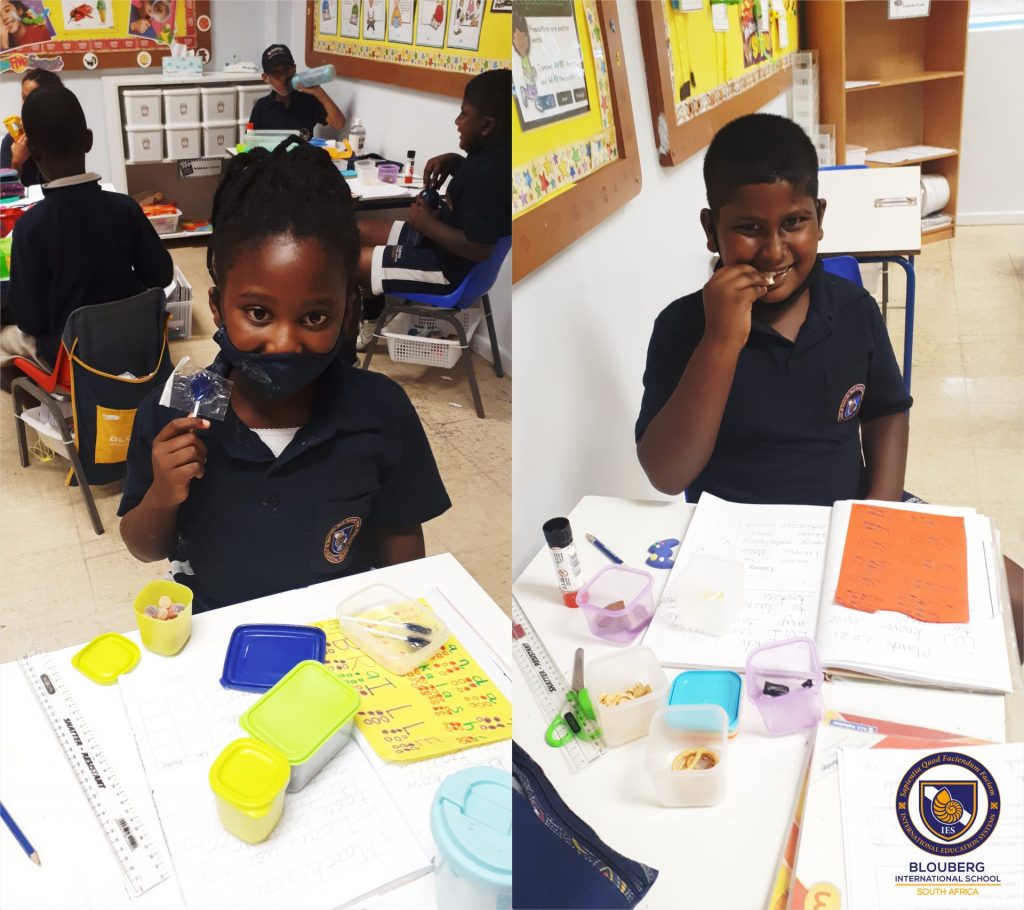
The students were asked to bring in small containers, containing something that tastes sweet, salty, bitter, sour and spicey. They had the opportunity to first smell each one and describe how it smells. Each student then had to fill in a table to say if they liked the taste or disliked it. The tasting bit was super fun! Just not bitter and sour. Those flavours received a number of thumbs down.
Next, the students will be making ‘Taste Monsters’ to complete their tasting experience. I am looking forward to seeing how those will turn out.
We hope that our Year 3 students will continue to experiment using their five senses, and always remember why they are so important.
Wendy Menton
Year 3 Teacher

Hands on Chemistry
In Chemistry this term, we have focused on hands-on, student-centered learning. Chemistry is an interactive subject and what better way to experience science than to “do science”. Benjamin Franklin is quoted as saying “Tell me and I forget, teach me and I may remember, involve me and I learn”.
In Year 9, students are learning about the structure of atoms and where electrons are found around the nucleus. In order to understand this concept, students played a game with giant-sized atoms and had to correctly place poker chips representing electrons around a nucleus. The game became quite competitive and students very quickly learned their way around the Periodic Table.
In Year 10, students made their own soluble and insoluble salts and filtered and crystallised these to separate them from impurities. Different separation methods are used for different salts and so it is important that students can correctly identify and explain these methods. In the external IGCSE examinations, students write an alternative to practical examination. Hands-on experience in the laboratory is essential for students to understand laboratory techniques and be able to design their own experiments.
The Year 11 students started the AS Chemistry syllabus this term. Students are required to master laboratory techniques as they are assessed on this in an individual practical examination next year. As we cover the necessary theoretical concepts in class, we have done practicals to apply these concepts. Students are becoming more and more confident working individually and are able to obtain accurate experimental results. They have done both titration and gravimetric practicals.
The students in Year 12 had a challenging start to the AS Chemistry course with COVID-19 last year. We were not always able to do a practical experiment at the same time as the theoretical concept was introduced. But students are back in the laboratory this term, and with some extra lessons and hard work, they have been able to complete many practicals already. We have covered all possible laboratory techniques needed in the course and I have seen a marked improvement in the students’ laboratory skills. We are focusing on accurate data presentation and using appropriate data calculations.
This year BIS is also offering A-level Chemistry in Year 13. The syllabus compliments the AS syllabus and students enjoy this course because the added detail explains the trends and concepts covered in Year 11 & 12.
Philippa Goch
Chemistry Teacher – IGCSE, AS and A-level


Necessity Is The Mother Of All Invention – (Plato)
We all know children love and need to play. During these trying times, break times are not as much fun as they used to be. Wearing masks in this heat, social distancing, etc. are not conducive to an exciting playtime for young children.
The same can be said for ‘free time’ in the classroom. Getting together in groups playing card games, or building Lego together is just not an option. Drawing a picture or colouring in can become pretty boring. Some students in my class decided to make paper jets, which was a good idea, until ducking flying objects became a hazardous situation, not to mention a distraction to students still completing work.
But, as Plato said, necessity IS the mother of invention. Last week, I observed some students taking to the field, flying their paper jets, and having races! I really was impressed at how these young minds saw a problem and created their own solution. They had so much fun, that this has become the norm most break times.
Kim Coetzer
Year 2 Teacher


Read More

The Science of Life
Biology is the study of living organisms, both in terms of their structure (anatomy) and how their different parts function (physiology). The cell is introduced as the basic unit of life, which then form tissues, organs, systems and ultimately an organism.
Biology can be divided into many different fields of study, such as biochemistry, genetics, microbiology and biotechnology to name but a few. Each of these directions delve deeper into the complexity of being alive. As a school subject Biology skims the surface on all these topics to provide a platform from which to launch for those interested in further studies at university level. It is important to understand how the different components of an organism function together as a whole. The intricacy of organs such as the heart or the eye is astounding and every part of these structures have a very specific and complementary purpose. Emphasis is placed on the practical application of Biology in the real world, from developing vaccines for infectious diseases, how gene therapy is able to provide hope to people with currently incurable conditions to understanding the impact of lifestyle choices on our health. Biology often overlaps with Chemistry as we investigate the chemical components of cells and study the equations of photosynthesis, respiration and the binding of gases to haemoglobin in blood. Mathematical calculations also make a regular appearance in Biology papers and is a necessary skill that students require.
Practical work is another important component of Biology as it gives students the opportunity to handle apparatus and chemicals, while conducting a scientific investigation based on work covered in class. Other skills developed are the ability to present the results obtained from practical work in a suitable table as well as reading and interpreting graphs. AS students begin preparation for their practical exam from Year 11 to ensure they have the necessary confidence and skills when the Cambridge exams arrive. The Year 12’s recently did a practical where they investigated the effect of different concentrations of an enzyme (catalase) on the breakdown of hydrogen peroxide. Filter paper discs were soaked in a solution containing catalase and then placed in a container with hydrogen peroxide. As the enzyme breaks down the peroxide it produces oxygen gas which causes the filter paper discs to rise to the surface. Students had to time the movement of the discs dipped in different concentrations of catalase.
Biology is a subject which provides countless career options, especially in the field of medicine or research. It is a diverse Science involved with finding answers to some of life’s most interesting questions. Despite the biological advances made over the years there are still many things to learn and discover.
Marlene Feltoe
Biology Teacher


Change Is Good
“For the things we have to learn before we can do them, we learn by doing them.” – Aristotle
This term in Year 6, we have been learning about Material changes. The students have been focusing on topics such as reversible and irreversible changes, mixing and separating solids, soluble and insoluble substances, separating insoluble substances, solutions, how can we make solids dissolve faster and how does grain size affect dissolving.
It has been a very interesting journey for the Year 6’s as experiments have been conducted each time they learnt about a new topic. They tested each of the above topics and came up with their own predictions, methods, results and conclusions. I hope that they cleaned their parents kitchen straight afterwards!
Here are some things the students enjoyed about Science:
“Well in science I really enjoyed conducting the experiments and finding out some things that I didn’t know, for example, I did not know why things dissolve faster in hot water but I then did the experiment and checked my textbook, I found out the answer. I also liked making the picture that we did at the beginning of the term about irreversible and reversible changes.” – Treasure Daniel
“I really enjoy the experiments because they give me a greater understanding on how things work like solutions and dissolving it is really fun.” – Maia Davies
“The thing I like about science is that when I conduct an experiment it makes it easier for me to understand the lesson. Like for the insolubles as I did the experiments it helped me understand and for the irreversible work when the teachers told us to make pictures in our book it helped because I used highlighting, so it stood out in my book. In science I’m 100 percent understanding the work.” – Yadar Mashoene
“On online schooling in science, we have learnt about material changes, solutions and mixtures, soluble and insoluble substances, different methods on how to separate mixtures and solutions, factors that affect dissolving, how to conduct a fair experiment and how to record our results. My favourite part of science is conducting experiments and learning the outcome of each one. I also enjoy learning about how to separate different mixtures and solutions.” – Saumya Maharaj
We are very proud of the excellent work our Year 6 classes are consistently producing!
Brittney Hakime
Year 6 Teacher

Year 2 Science Experiment
“Science is simply the word we use to describe a method of organising our curiosity” – Tim Minchin
This week for science our Year 2 students were asked to do a fun home experiment on Dissolving Matter. The test was to see which out of the given products would dissolve in a cup of water. Each child was given a worksheet where they could state their prediction of the probability of the product dissolving in the water, and also where they could record their findings after testing each. At least 5 or 6 cups of water was needed, placing each product in one cup at a time and stirring thoroughly. Some of the products used included salt, coffee, hot chocolate, soap, cooking oil, sugar and chalk. This is an exciting and fun way to watch as the product either sinks to the bottom, rises to the top or dissolves into the water completely. The important part is to watch and record as you’re going to make sure you’ve learned from your experiment and are able to ask more questions that will lead you to the next one.
Curiosity and discovery go great together. Much fun was had by all!
Siobhan Hendry
Year 2 Teacher


Virtual Orbit – E-learning Launch in Year 4
The year 4 classes started the second term launched into virtual orbit. We have all had to learn how to navigate Google Classroom, when to talk and when to be quiet in a Google meeting and how to upload and mark completed work.
I am so proud of how our students have owned their own learning. Cambridge education emphasises the development of students who can think, solve problems and actively take responsibility for their own learning. We must be doing something right, for this is what I saw over and over again today.
What absolute stars our students are. Thank you to the parents too, for making launching such fun. I look forward to tomorrow and the rest of the adventure online.
Carey Schoots
Year Teacher


It’s Cloudy In Year 3!
Clouds
The students presented their clouds and shared their favorite type of cloud with the class. Learning about the different types of clouds through art was exciting.
What is your favourite type of cloud?


Chemistry
Chemistry at Blouberg International School is experiential and hands-on; students conduct experiments, research ideas and work together in order to understand the world around them.
In simplified terms, the science of chemistry deals with the properties, composition, and structure of substances and how these substances interact with one another. In the IGCSE, AS and A-level chemistry curricula, topics of study are divided into three broad categories: physical chemistry, inorganic chemistry and organic chemistry. In each category students learn about chemical theories and processes that are relevant to their lives and to the challenges faced in the world around us.
A strong emphasis is placed on how past and current chemical processes affect the environment and the lives of others. We have had many lively classroom debates about alternative sources of energy, agriculture and the use of fertilizers, food security and transport. The Cambridge curriculum allows students to be exposed to scientific applications on a global level – illustrating how countries around the world have approached these issues and found possible sustainable solutions. Our classroom discussions have also focused on solutions for the African and South African context: identifying our unique resources and challenges and how we can improve on our current processes.
Practicals are another important component of chemistry. Students are empowered to work independently, make discoveries for themselves and apply their theoretical knowledge in a laboratory setting. In the final AS Chemistry examinations, each student carries out their own two-hour practical in which they complete both quantitative and qualitative analyses. Using both their theoretical knowledge and practical laboratory skills, students calculate the quantity of a compound given using various laboratory techniques. In the second half of the examination they apply their knowledge to identify unknown substances using various chemical tests. The AS and A-level curricula prepare students very well for university by providing them with a solid foundational understanding of chemistry principles and laboratory techniques.
Philippa Goch
High School Chemistry Teacher


Year 2 Experi-buddies Inting
“Our greatest weakness lies in giving up. The most certain way to succeed is always to try just one more time” – Thomas Edison
In science, this term, our Year 2’s are learning about all the wonders of electricity! We are so excited for fun in class and exciting new experiments.
This week we enjoyed a visit from the Experi-buddies team. Our Inting started with a small demonstration from the team where we learnt about what Electricity is and who Thomas Edison was. After this we got into batteries and how we can use them to power up light bulbs, set off buzzers and even power up a small fan.
Our favourite part was when we got to go back to our tables and start experimenting with our own batteries and light bulbs. We learnt about open and closed circuits and exactly what we need to make the light go on. We also learnt about solar power and how that works, after experimenting with light switches too.
It was so much fun learning about things we are able to find and observe in our everyday lives!
Visit the link to learn more about Experi-buddies:
Siobhan Hendry
Year 2 Teacher